What Was Jotaro Truly Fighting in Part 3?
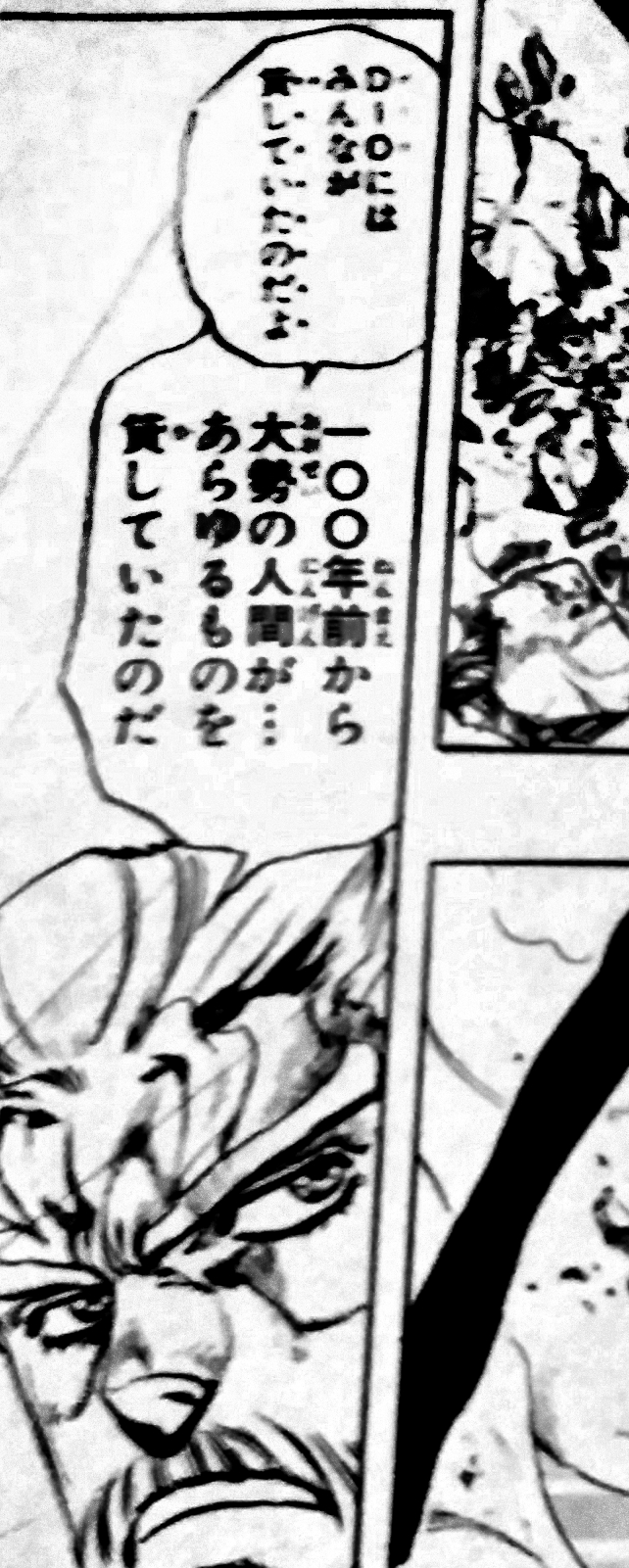
The conversation after defeating DIO
After defeating DIO in Part 3, there is a profound conversation between Jotaro and Joseph.
What does it mean that “countless people” had “lent” “all kinds of things” to DIO “for a hundred years”? In reality, DIO was supposed to have been inside a coffin for those one hundred years, during which he was completely unable to act. Here, “lent” does not mean temporarily lending something to someone, but rather surrendering something that one ought to have always held onto oneself. People did not simply have these things taken from them against their will; they actively and voluntarily gave them up. This, I believe, is Araki’s original message.
This line of Joseph’s must carry a profound, universal significance. Deciphering it is the key to understanding Part 3.
Japan at the Time
Part 3 is set in Japan in 1989, which was the present day during its serialization. Jotaro is a Japanese high school student, and he is someone who says things like this:
この空条承太郎は…いわゆる不良のレッテルをはられている… ケンカの相手を必要以上にブチのめし、いまだ病院から出てこれねえヤツもいる イバルだけで能なしなんで気合を入れてやった教師はもう2度と学校へ来ねえ 料金以下のマズイめしを食わせるレストランには代金を払わねーなんてのはしょっちゅうよ
だが、こんなおれにも吐き気のする「悪」はわかる!「悪」とはてめー自身のためだけに、弱者を利用しふみつけるやつのことだ This Kujo Jotaro… has been labeled a so-called “delinquent”… I’ve beaten up people I’ve gotten into fights with way more than necessary—some of them still haven’t been able to get out of the hospital.There was a teacher who thought I was just a cocky good-for-nothing, so I gave him a good beating—he’s never set foot in the school again.It’s a regular occurrence for me to refuse to pay at restaurants that serve food that’s worse than what you’d expect for the price.But even someone like me can recognize “evil”—the kind that makes me sick to my stomach!
“Evil” is someone who exploits and tramples on the weak purely for their own benefit. Kujo Jotaro (Part 3, Vol. 13)
It is a line that would be difficult to have a modern protagonist say. For modern readers, there is likely a feeling that he should obey the law before preaching about “evil.” With such a protagonist, it is difficult to view him as being on the side of justice.The desire to exclude such an anomaly would likely cause a stir online today. While this dialogue was viewed simply as a standard manga expression at the time, the environment has changed. Now that anyone can post blogs and videos explaining the work, one often encounters Japanese articles that view this line of Jotaro’s negatively. Jotaro’s behavior as a delinquent appears to contrast sharply with Jonathan. Jonathan took pride in his gentlemanly conduct as an English aristocrat and stood to maintain “order.” Even so, there is no doubt that Jotaro inherits the will of the Joestar family. In the modern era, perhaps our awareness has shifted toward the difficulty of viewing “order” itself as justice.
Japan at the time was on the cusp of the bubble economy’s collapse, with economic growth reaching its peak. As everything became more convenient, life grew wealthier, and social order stabilized. While there was a tangible sense of material improvement, there was also a growing sense that something less visible was being lost—something fundamentally human. The more obvious the improvements to everyday life became, the harder it was to put this loss into words. Giving shape to this sense of unease became one of the key roles of subculture. One of the symbols of this era was “regimented education,” in which schools treated uniformity and unquestioning obedience to authority as ideals. It reflected a broader sense that blindly following order was not necessarily the same as doing what was right. As a reaction to this, the “delinquent” protagonist emerged as a counterpoint to a society increasingly defined by management and conformity. Not limited to JoJo, manga of the era often placed this spirit of rebellion at the center of their stories. Behind the easily understood gains of a more convenient and orderly society, they sought to give form to something much harder to see: the sense that something was being lost.
What was the nature of their rebellion? Along with rapid economic growth, society came to be dominated by two principles: the “consumer society” and the “competitive society.” With an abundance of goods and information, being superior to others, newer, and more efficient was deemed good. Rather than simply purchasing necessities for daily life, advertisements and media stimulated desires. The act of “acquiring” goods and services became the very center of self-expression and social value. Rather than the physical function of goods, people began to consume the symbols behind them, such as image and status. Acts of consumption deeply penetrated how they defined meaning in their lives. Without realizing it, people competed for their positions within a system of values prepared by society. They were forced to live in a way that kept them from falling out of line. “Free choice” was merely freedom within a given set of options. Even individual judgment and desire became subordinate to the social system.
The “meaning of life,” which once arose from within oneself, was replaced by external evaluations and numerical metrics. Even success, efficiency, beauty, and happiness came to be defined by comparison with others. Consequently, people began to lose “being themselves.” This was a process in which human beings were reduced to mere parts of a function within a society powered by consumption and competition. This phenomenon of the “loss of self” was not just a side effect of the era, but the very essence of the “system” itself. My interpretation is that DIO represents this “system” in an abstract sense.
Flesh Buds
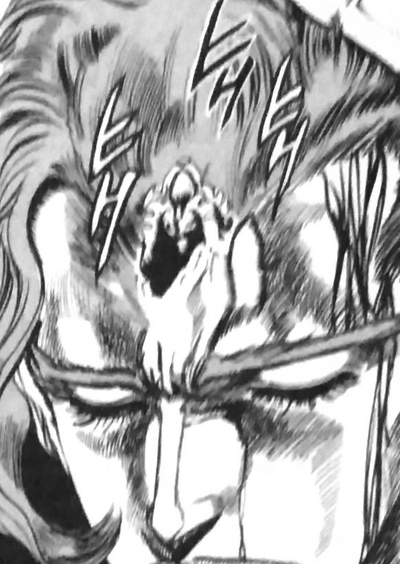
In the past, Dio created servants by turning people into zombies, but doing so made them vulnerable to sunlight. In Part 3, DIO begins to control people by implanting Flesh Buds. As Joseph’s following line indicates, DIO exploits a “certain feeling” that circulates in the world:
つまり、この肉の芽はある気持ちを呼び起こすコントローラーなのじゃ‼
カリスマ! ヒトラーに従う兵隊のような気持ち! 邪教の教祖にあこがれる信者のような気持ち!
この少年はDIOにあこがれ、忠誠を誓ったのじゃ‼ That is to say, this flesh bud is a controller that evokes a certain feeling!
Charisma! Feelings like those of a soldier following Hitler! Feelings like those of a follower who idolizes the leader of a cult!
This boy admired DIO and swore his loyalty to him! Joseph (Part 3, Vol. 13)
Erich Fromm’s famous book “Escape from Freedom” explains the feeling of “a man to follow Hitler” from the perspective of social psychology. Fromm, a German-born Jew, fled the Nazi regime and emigrated to the United States. There, he investigated the psychology of citizens whose homeland was leaning toward Nazism and totalitarianism. His analysis takes as its starting point the way humanity has historically acquired freedom. With the development of civilization—such as the discovery of fire, the creation of tools, and agriculture—humanity gained control over food, clothing, and shelter. This allowed for freer lives. This meant acquiring freedom from the state of being bound by nature. As civilization progressed further, freedom of occupation and religion, suffrage, and the free market were established. The things that had previously bound people were removed one after another. This process began with the telegraph and telephone, eventually extending to the internet and smartphones. Humanity gained the ability to exchange information with anyone, anywhere, at any time. This removed even physical distance and temporal constraints. The ways of life individuals could choose became more diverse than ever before. In this way, as we approach the modern era, the outline of the individual has become clearly emphasized. It has become possible to choose various ways of life as an individual, deciding where and how to live.
The freedom that has expanded in this way demands that the individual confront a colossal external world. In other words, the expansion of freedom creates a heavy burden of responsibility for one’s own decisions. In a free market, it is impossible to predict what will sell and to what extent, which breeds anxiety. When competition arises between individuals and solidarity is lost, it creates loneliness. One’s own insignificance in the face of a massive society generates a sense of helplessness. To be liberated from such anxiety and loneliness, a psychology emerges where individuals choose to discard their freedom. Instead, they choose to submit to something. Fromm described this as the “escape from freedom.”
Liberation from the constraints of nature or social structures is expressed through the metaphor of independence from one’s parents. Those who cannot achieve independence seek submission to a reassuring parent figure. However, for a humanity clinging to civilization, that original, comforting parent no longer exists. Thus, people throw themselves into “something” they can submit to, no matter how distorted it may be. The stronger the faith in that “something,” the more it justifies a violent psychology. This psychology seeks to exclude others perceived as threats to that belief. A charisma that is colossal, absolute, and whose submission breeds tranquility. In Germany during World War II, the Nazis and Hitler were elevated by the people to occupy precisely this position.
N’Doul, who appears in Volume 20, was an enemy. However, Jotaro respected his noble fighting spirit to the extent that he even buried him. Jotaro asks why such a man would swear loyalty to DIO.
スタンドの能力のせいで子供のころから死の恐怖なんかまったくない性格だったよどんなヤツにだって勝てたし犯罪や殺人も平気だった… 警官だってまったく怖くなかったね…
そんなおれが はじめてこの人だけには殺されたくないと心から願う気持ちになったその人は あまりにも強く 深く 大きく 美しい…そしてこのおれの価値をこの世で初めて認めてくれたこの人に出会うのをおれはずっと待っていたんだ
死ぬのはこわくない しかしあの人に見捨てられ殺されるのだけはいやだ悪には悪の救世主が必要なんだよ Because of my Stand’s ability, I’ve never had any fear of death since I was a kid.I could beat anyone, and I didn’t mind committing crimes or even murder… I wasn’t afraid of cops at all, either…
And yet, for the first time in my life, I found myself truly wishing from the bottom of my heart that I wouldn’t be killed by this person. This person is so strong, so deep, so vast, so beautiful… And I had been waiting my whole life to meet this person—the first person in this world to recognize my worth.
I’m not afraid of dying. But the one thing I can’t stand is being abandoned by him and killed. Evil needs an evil savior. N’Doul (Part 3, Vol. 20)
DIO, Who Grants “Peace of Mind”
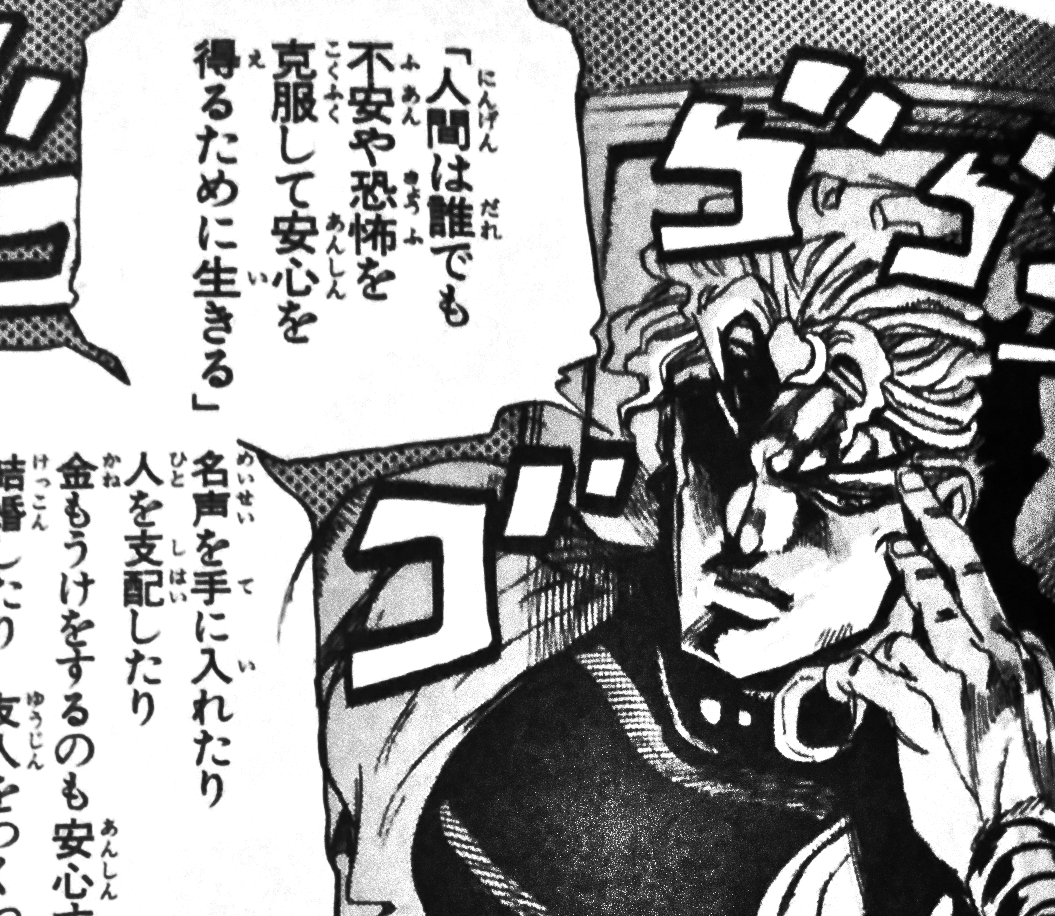
DIO possessed a talent for manipulation since childhood, but in Part 3, this genius is refined even further. What is repeatedly depicted as his method of control is his appearance of granting “peace of mind” to people.
人間は誰でも不安や恐怖を克服して安心を得るために生きる。名声を手にしたり、人を支配したり、金もうけをするのも安心するためだ。結婚したり、友人をつくったりするのも安心するためだ。人のために役立つだとか、愛と平和のためにだとか、すべて自分を安心させるためだ。安心を求めることこそ人間の目的だ。
そこでだ…わたしに仕えることに何の不安感があるのだ? わたしに仕えるだけで、他の全ての安心が簡単に手に入るぞ。 今のおまえのように、死を覚悟してまでわたしに挑戦することのほうが不安ではないかね? おまえはすぐれたスタンド使いだ…殺すのはおしい。 ジョースターたちの仲間をやめて、わたしに永遠に仕えないか? 永遠の安心感を与えてやろう Every human being lives to overcome anxiety and fear and find peace of mind. Seeking fame, exercising control over others, and making money are all done to achieve peace of mind. Getting married and making friends are also done to achieve peace of mind. Whether it’s helping others or working for love and peace, it’s all done to bring oneself peace of mind. The pursuit of peace of mind is the very purpose of human existence.
So then… what exactly are you afraid of when it comes to serving me? Just by serving me, you can easily gain peace of mind in every other aspect of your life. Isn’t it more frightening to defy me—as you’re doing now—to the point of being prepared to die? You’re an exceptional Stand user… it would be a shame to kill you. Why don’t you leave the Joestars’ group and serve me for eternity? I’ll grant you eternal peace of mind. DIO (Part 3, Vol. 27)
These are words spoken by DIO to Polnareff. He once served as DIO’s assassin. In other words, he has a past of succumbing to the “peace of mind” offered by DIO. Although he regains himself through his encounter with Jotaro, the temptation remains. When confronting DIO again, DIO attempts to grant “peace of mind” to the betrayer Polnareff. He does this in an extremely gentle and persuasive manner, causing Polnareff’s heart to waver. His other companions, Kakyoin and Avdol, also admit that there is a sense of comfort in DIO’s words. They view resisting this comfort as the path they must follow, the very purpose of their adventure.
To use Fromm’s perspective, humanity originally started from a state of “peace of mind.” In Escape from Freedom, he deciphers the biblical “Garden of Eden” as a story of the moment humanity acquired freedom. Here, we can consider the “the tree of knowledge” in Garden of Eden to represent humanity before acquiring civilization.
Man and woman live in the Garden of Eden in complete harmony with each other and with nature. There is peace and no necessity to work; there is no choice, no freedom, no thinking either. Man is forbidden to eat from the tree of knowledge of good and evil. He acts against God’s command, he breaks through the state of harmony with nature of which he is a part without transcending it. From the standpoint of the Church which represented authority, this is essentially sin. From the standpoint of man, however, this is the beginning of human freedom.Erich Fromm, Escape from Freedom
In other words, human beings made the seemingly unthinkable choice to leave the “Garden of Eden” where absolute “peace of mind” existed. Through this choice, they transcended “mere life” and became human in the true sense.To gain freedom is to choose, to think about that choice, and to take responsibility for that choice. Yet at the same time, by acquiring freedom, people lose the “security” and “sense of unity” they once had. They lose the comfort of leaving things to someone else. Freedom also means departing from security, and the process inevitably involves “anxiety” and “fear.”
Action that merely avoids “fear” is, after all, nothing more than “mere life.” As Zeppeli stated in Part 1, to know “fear” and overcome it is precisely what constitutes “courage.” This is impossible for mere life and can be described as “something only humans can do.”
DIO’s invitation to eternal “peace of mind” runs counter to the history accumulated by humanity, representing a regression to “mere life.” Naturally, humans are also living organisms. Emotions such as “security,” “anxiety,” and “fear” are fundamentally necessary for life. Contrasting emotions, thoughts, and actions clash, maintaining balance. This tension has deepened thought, prompted action, and pushed civilization forward. In this way, humanity has accumulated a level of diversity and creativity that is “impossible” under the laws of nature. In the modern era, civilization has developed and moved far from the “Garden of Eden.” Consequently, people are sinking into a deeper abyss of “peace of mind” than ever before. To step even a single pace out of that “peace of mind” accompanies unprecedented fear. Through the accumulation of this “peace of mind” and fear, matured over a century, DIO’s “evil” manifests in its completed form.
What we lent
Returning to Part 1, checking the opening narration that describes the setting, nineteenth-century England is explained as follows:
一九世紀!
それは産業と貿易の発展が人々の生活と思想を変えた時代だッ!依然! 食糧不足や貧富の差が激しいにもかかわらず大人も子供も「自分もいつか金持ちと同じようなくらしができるッ」このような幻想をいだいていたッ!
それは嵐のようなすさまじい渇きだったッ! The 19th century!
That was an era when the development of industry and trade transformed people’s lives and ways of thinking! Even then, despite food shortages and extreme wealth inequality, both adults and children harbored the illusion that, “Someday, I’ll be able to live just like the rich!”That was the fantasy they clung to!
It was a thirst as fierce as a storm! (Part 1, Vol. 1)
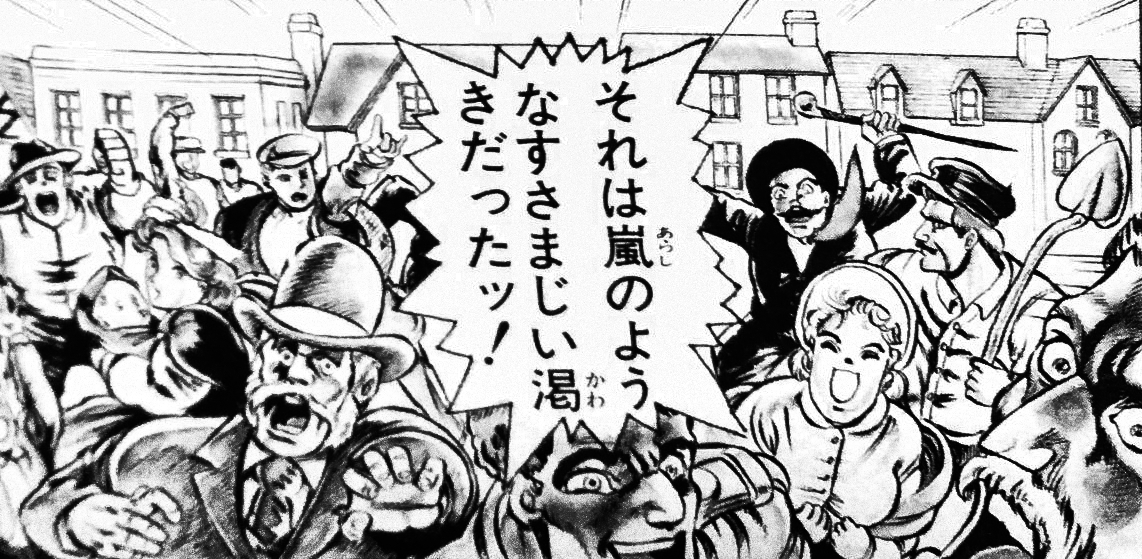
This panel serves to establish the setting, but if you look closely, you’ll notice that this explanation is actually unnecessary to the story of Part 1. The concept of civilization has little bearing on what follows. So why did Araki insert this panel here?
From “Part 1: England” to “Part 2: America,” and then “Part 3: Japan”—this transition occurs. This shift in the protagonists’ birthplaces seems to symbolize the very causal flow of civilization being transmitted to Japan. The driving force behind this flow is precisely the thirst shown in the aforementioned narration.
This thirst pushed civilization forward. Yet at the same time, it also led to human beings sinking into the system, resulting in a loss of humanity. In exchange for stability within a given order, people surrender their own emotions and will. This is likely what they had “lent” to DIO. Even though “there are too many things that never come back”, there are still things that can be returned. If we trace the driving force for reclaiming these “lent things” to its source, we arrive at the most primitive “individual emotion.” This is the furthest thing from the “system.”
DIO’s defeat is due to a single reason:
てめーの敗因は…たったひとつだぜ… DIO たったひとつの単純な答えだ
『てめーはおれを怒らせた』 The reason you lost… is just one thing… Dio… It just one simple reason.
“You pissed me off.” Jotaro (Part 3, Vol. 28)
Walkman
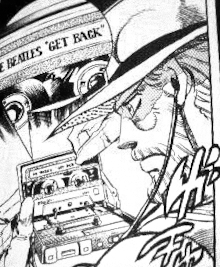
At the beginning of Part 3, Joseph, having just arrived in Japan, remarks that he likes Walkmans. Then, after the long battle is over, the three survivors part ways at the airport, where Joseph is shown listening to a Walkman. The Walkman was developed by Sony in 1979, and it stands as a symbol of how Japanese technological innovation transformed the lives and culture of people around the world.
What JoJo ultimately portrays is an overwhelming affirmation of human endeavor itself—an idea encapsulated in the phrase “a hymn to humanity.” The battle against DIO’s “peace of mind” is by no means a rejection of civilization. Rather, it asks how we are to live while benefiting from civilization and all that it has given us. To live without simply settling for what has been given to us, to remain true to our own will, and to willingly face the consequences of our choices. That attitude, I believe, is what JoJo’s “hymn to humanity” is ultimately about.