The Nature of Evil in JoJo
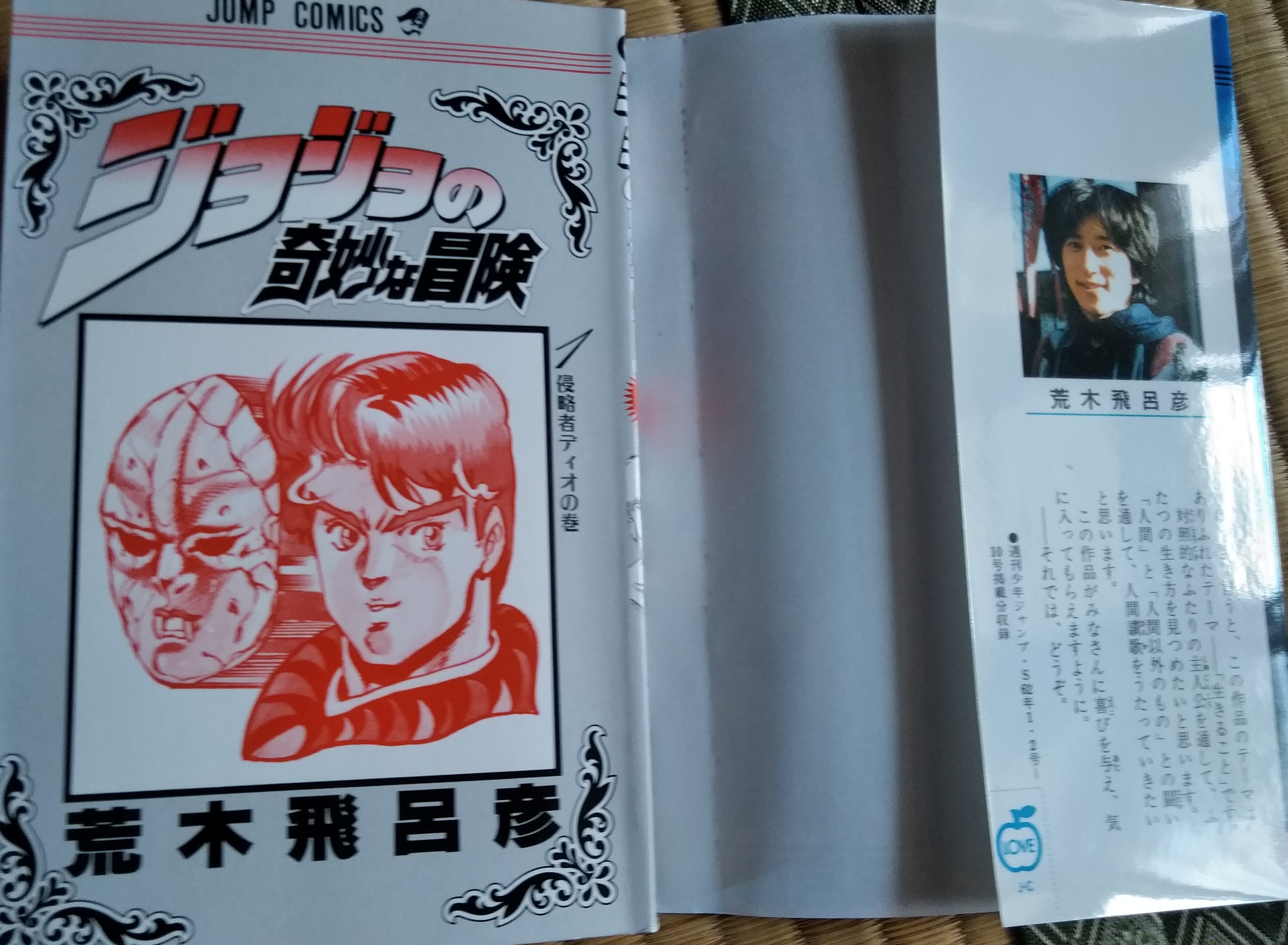
On the inside cover of Weekly Shonen Jump paperback volumes, there is a note from the author. In the first volume of “JoJo’s Bizzare Adventure”, the following words are written:
はっきり言うと、この作品のテーマはありふれたテーマ……「生きること」です。対照的なふたりの主人公を通して、ふたつの生き方を見つめたいと思います。「人間」と「人間以外のもの」との闘いを通して、人間讃歌をうたっていきたいと思います。 To put it bluntly, the theme of this work is a common one… “living”.Through these two protagonists who are complete opposites, I would like to explore two different ways of life. Through the struggle between “humans” and “non-humans,” I hope to sing a hymn to humanity. Author’s Note (Volume 1)
From its very inception, the core of the story of JoJo is explicitly stated to be a hymn to humanity. And what is noteworthy is that Araki speaks of “two protagonists,” establishing a clear dichotomy of “humans” versus “non-humans.” The symbol of “humanity” here is Jonathan Joestar, and the “non-human” confronting him is Dio Brando. By positioning an evil character as an another protagonist in Part 1, JoJo establishes a unique approach to evil. Dio, raised in an environment of poverty and violence, is cornered by Jonathan and ultimately chooses to “reject his humanity” of his own free will.
Araki and “Evil”
Araki is a creator who perceives a powerful aesthetic and philosophical depth within “evil” as a subject. This is evident from his later book, Araki’s New Manga Theory: How to Create Villains. His interest in protagonists devoid of goodness can already be observed in Cool Shock B.T. (Shueisha), a series he serialized prior to JoJo. At the beginning of the story, B.T. is introduced as follows:
社会的ダイナマイト一発即発的良心罪悪感ゼロ的猛毒セリフ的悪魔的計算頭脳的今世紀最大的犯罪少年の身も心も凍りつくエピソードです! This is a spine-chilling episode of a boy of the century—social dynamite ready to explode, zero conscience, zero guilt, spitting venomous remarks, possessing a diabolical calculating brain! From Cool Shock B.T.
With many similarities in both appearance and personality, B.T. feels like a prototype for the character of Dio who would emerge years later. B.T. lacks the goodness typically expected of a protagonist in shonen manga, running through the story from beginning to end without “conscience” or “guilt.” That said, his malice is never directed at good-natured people, and since his adversaries are also unlikable characters, the series does not leave a bad aftertaste. Even so, the story offers no moral lessons whatsoever. There are no developments where B.T. turns out to be “actually a good guy” or “realizes what truly matters.” Nor does he face karmic retribution where doing bad things backfires on him. What drives the narrative is the suspense of B.T. using his intellect to extricate himself from tight spots. Even in critical situations, he remains calm, never stops analyzing the circumstances, and acts without hesitation based on his own convictions—a mental strength that forms the core appeal of the story. Araki seems to be deeply drawn to such existences that deviate from the boundaries of good and evil.
The Uniqueness of Evil in JoJo
Traditionally, narratives of the conflict between good and evil are often depicted to generate a sense of exhilaration and security when evil is defeated and order is restored. On the other hand, for individuals harboring repression and frustration in their daily lives, characters who mock conventional values and live solely by their own power can serve as a source of liberation and catharsis. Furthermore, many works focus on an evil protagonist to expose the harshness of the society surrounding them or the hypocrisy latent within what is deemed “justice.” JoJo fits none of these categories.
Dio is depicted as thoroughly “evil.” He repeatedly commits socially unacceptable acts that go against morality. From childhood, he excels at manipulation, cleverly turning friends against him to isolate and mentally break him. As the story progresses, no hidden goodness is revealed, and his behavior of exploiting everything for his own benefit is maintained consistently to the end. Yet, this does not mean Dio is merely an adversary who exists to be defeated.
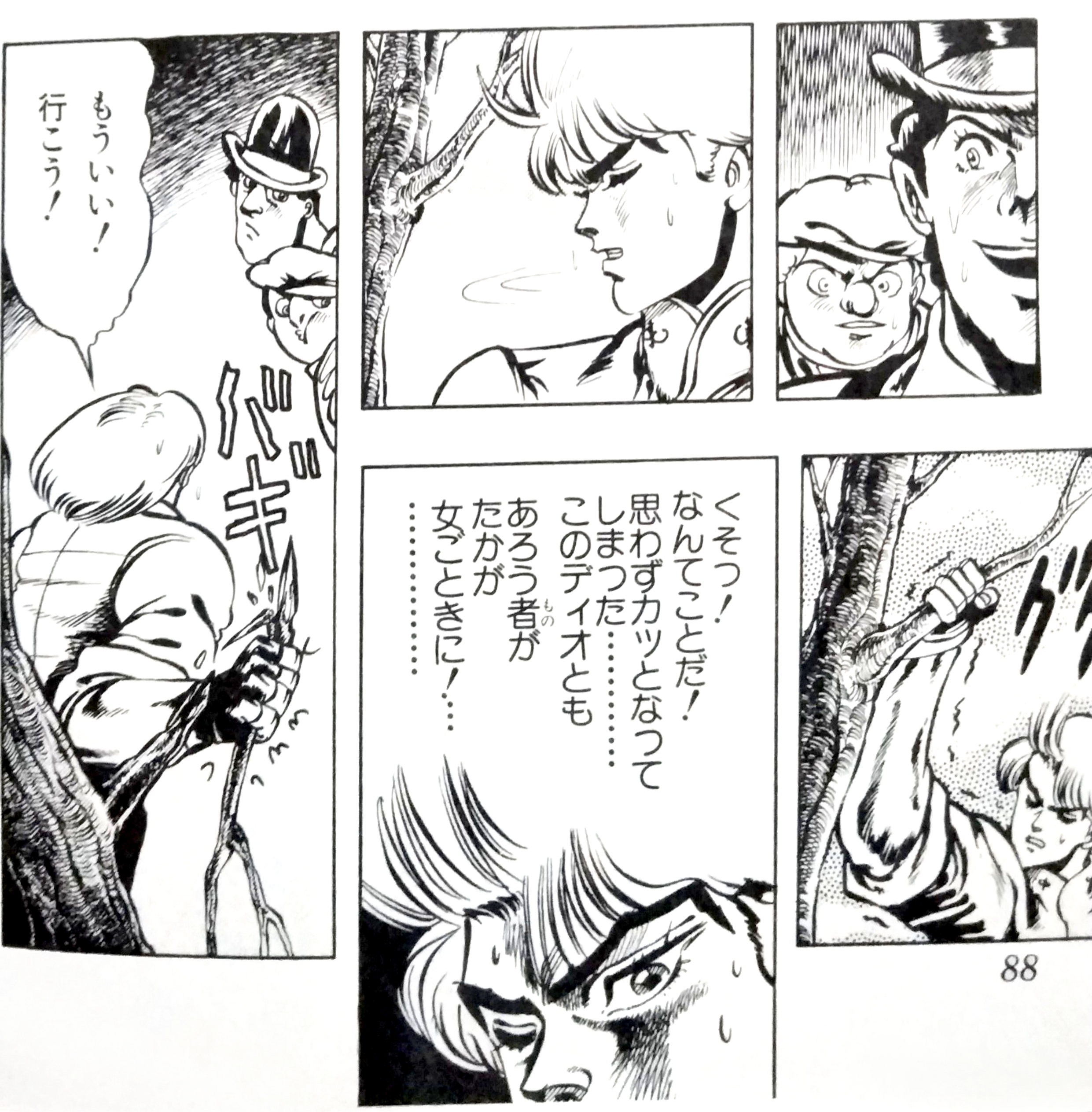
An important scene that demonstrates the nature of “evil” in JoJo takes place in Volume 1. It is the scene where Erina, after having her lips stolen by Dio, washes her mouth with muddy water. Unable to endure her defiant attitude, Dio loses his composure and strikes her. Immediately afterward, he is depicted regretting this action, which marks his first mental defeat. JoJo is a story of competing in the “caliber” of one’s spirit.
Meanwhile, in this scene, Dio’s lackeys wear expressions of excitement at his cruelty. Evil possesses a charm that attracts people, and Araki depicts this without pretense. However, he relegates such psychology to background characters as a low-level desire stemming from human weakness, distancing it from the core of the narrative. By depicting Dio’s spiritual defeat and the way he grows by confronting it, Araki guides the reader’s gaze to a dimension distinct from the resentment-fueled admiration of evil.
A Gaze Beyond Good and Evil
Of course, it is clear that Araki also views goodness as the beauty of humanity. However, Araki does not create works by uncritically relying on easily shared values. He never predetermines the boundaries between good and evil, conforms to external norms, or remains bound by common sense. He constantly observes with his own eyes and questions. Herein lies Araki’s approach of translating his thorough observations directly into the narrative.
The depiction of attachment devoid of morality as a virtue is vividly illustrated in Joseph’s dialogue when he defeats Esidisi in Part 2.
俺はこいつと戦ったからよく分かる… こいつは誇りを捨ててまで、何が何でも仲間のため生きようとした…赤石を手に入れようとした。
何千年生きたか知らねえが、こいつはこいつなりに必死に生きたんだな…善悪抜きにして…。こいつの生命にだけは敬意を払うぜ! Through fighting this guy, I really came to understand… He was willing to give up his pride just to live for his comrades no matter what… He tried to get his hands on the Red Stone. I don’t know how many thousands of years he lived, but he lived his life to the fullest in his own way… setting aside questions of morality…
I respect this guy’s life, if nothing else! Joseph (Part 2, Volume 9)
Even after being defeated in battle by Joseph, Esidisi stubbornly possessed Suzi Q, tormenting Joseph and his companions. This was a despicable act of using Suzi Q for his own ends, representing nothing but harm to Joseph and the others. Yet, Joseph declares that he respects Esidisi’s life, disregarding any calculation of benefit or detriment to himself. The terms “good and evil” in this dialogue can be interpreted as an attitude that defines favorable actions as good and unfavorable ones as evil based on a specific established order, in order to maintain it. In this sense, “good and evil” are merely values of self-interest. By stripping these away, Joseph reaches a perspective where he can look at his opponent on the same plane and feel genuine respect.
There is a beauty inherent in life through its attachment to living and its sheer desperation. This is the absolute law of life, which drives all living things. Building upon this foundation, the very ability to adopt a perspective that “accepts this law,” as Joseph does, is precisely what is unique to humans; this is the “hymn to humanity.”
The Essence of the Hymn to Humanity
The same structure can be found between Jonathan and Dio in Part 1. To Dio, Jonathan is nothing more than an object to be plundered. Yet, accepting this as an inevitable law of nature, Jonathan ultimately came to feel respect for the sheer intensity of Dio’s will to live, which had driven his own life forward. Jonathan’s “friendship” toward Dio can be understood as resting upon this philosophical resignation to the laws of life.
In Part 1, Araki treats Dio as an another protagonist, meticulously depicting his development and portraying him as a charismatic villain to praise his unyielding spirit. This is because the question “What kind of humanity can overcome an evil spirit?” provides the answer to the question “Why does justice win?” Thus, JoJo begins by unraveling the nature of human existence through the contrast between “human” and “non-human.”